Songs of Water: An Interview With Stephen Roach

March 23, 2010 at 7:04 am

20041_315166611910_632531910_4120701_842052_nSongs of Water releases their second album “The Sea Has Spoken” today. The band plays largely instrumental music and has played with Ricky Skaggs among others. We recently spoke with band member/percussionist/hammer dulcermist, Stephen Roach, who also has a solo album out called “Closer to the Burning.” Stephen shares his background and his future, along with thoughts on instrumental music.

Were you raised in a musical home

Yes. Both sides of my family are musical, they’re all bluegrass musicians. My Dad is a third generation fiddle player. I definitely grew up around music. I didn’t always follow the same musical path as maybe my Dad and all my cousins did, but I actually did end up doing some bluegrass style music.

How did you first start playing music?

I don’t remember not playing music. I think I asked for my first drum set when I was five, so it’s just always been a part of me.

When did you begin to feel that music might be your life’s calling?

Probably not too long after that. I remember times when I was like eight-years old, I would take every chair in our house and set them up in our dining area like a concert hall and force my family to watch me bang on things. I think I even sold them tickets, so I had a marketing thing going on too.

When did you start writing music?

I started writing pretty seriously at a very young age, maybe around 12. I wrote a lot of lyrics, a lot of poetry and eventually started composing with other people.

How did you pick up the hammer dulcimer?

Percussion instruments are some of the primary things that I play, it just made sense for me. I was an easy leap because I had started doing a lot of drums and percussion work at an early age. Then when I started learning guitar and more things about melody and composition, the dulcimer was kind of the bridge between the two worlds. It is a percussion instrument, but it’s also kind of the great-grandfather of the piano. I just had this feeling, or maybe intuition that if I got this instrument, I would know how to play it. I went out and found one and just started playing it. I didn’t have any lessons or anything.

Were you raised in a Christian home?

I wasn’t raised in church, that’s probably an easier answer. I didn’t go to church growing up and didn’t really want anything to do with it. I did have some spiritual encounters early on in life but my experience of church at that time was just that it was a boring place full of moral codes. There wasn’t a lot of life there.

Would you mind sharing a bit about your salvation experience?

Sure. I don’t know that I can narrow it down to one particular time. Like I said, when I was around ten, I did have a pretty tremendous encounter with the presence of God. I knew that that was real and I pursued that for a while on my own, even at the young age of 10-12. When I really didn’t find any life in the church at that point, I began to search out other spiritual paths. For a lot of my teenage years, I spent a lot of time studying things like Buddhism and New Age philosophy and even occultic stuff, pretty much a smorgasbord of spiritual experience. Something real had been awakened in my heart when I was young, but I couldn’t find it anywhere. After a while, I got pretty heavily into Native American religion and even the drug experiences that go with that.

There came a point much later, after I experimented with all those things when, I didn’t even know to call God “God” at that point, the Native Americans referred to God as “The Great Spirit,” so I just said “Great Spirit, show me who you are and show me if you have a purpose for my life.” When I did that, Jesus was the only one who started talking. I told myself that if I was really as opened minded as I said I was, I owed it to myself to look into this again. Jesus hasn’t stopped talking and that was 12 years ago.

How does your faith influence your music?

Faith influences everything I do. I don’t see Songs of Water as any different than what I do when I lead worship on a Sunday morning. It all comes from the same place in me. It’s just different expressions. I think music in general, whether it’s acknowledged or not, is a powerful spiritual force. For me, my music is just an overflow of the deep things that I experience.

The more connected I get with the Creator, the more creative I become. I used to have this fear that if I quit doing drugs or if I was no longer depressed about life, I was going to lose all of my creativity because that was the source that I drew from. It was a real scary thing for me to undergo some of the transformation that happens when you encounter the Creator, but I found that over time, the closer I got to the Creator, the One who created everything, I began to create things I never imagined I could create prior to that relationship.

How does faith impact my art? It makes me ravenous to get to know God on a much deeper level. Because the deeper I go in that relationship, the more I get shocked at the creativity that comes out of my own life.

What’s the relationship between your solo output and music made as Songs of Water?

The solo stuff that I do is primarily geared toward people of like mind in the Christian faith. Lyrically, I deal a lot with topics about my faith and the journey of faith.

Do you have a typical songwriting process?

For me, I usually sit down and a lot of the personal songs I write, I just sit down and play and a lot of times, things just emerge and then I craft them over time. A lot of times, I’ll add poetic fragments I’ve written along the way. I usually experiment with interpreting songs on different instruments. I have a tenor banjo that I like to write on a lot. With the band though, everyone in the band is a songwriter so one of us will come up with an idea and we’ll experiment with it on different instruments. We love to improvise and just see what comes out of it. A lot of times, it just seems like the music will have a particular way that it wants to go. It’s almost like we spend more time listening than writing. When the piece is finished, we often look back and just say “Wow, this is so much bigger than what we had envisioned!”

Why separate your musical output into these two different expressions?

One is a collaborative effort and one is just strictly my own writing. It’s really just the collaborative effort that makes the difference for me. I love writing with the band. You come up with some pretty interesting things when you get six different heads together from six different perspectives all putting parts together. The music I write on my own is a lot more personal. But then again, the two lyrical songs on the new Songs of Water album are songs I wrote myself.

Is the instrumental music a different experience for you?

I love playing instrumental music. Sometimes, there are just things in the heart, imagination or spirit that you just can’t express with the limitations of words. I love language, I love poetry, word imagery, but there comes a point when you’re limited by the strict definition of the words that you choose. With instrumental music, you’re not inhibited by those limitations. I can express something of the depth of my thought process and experience through instrumental music in a way that can reach out to a broader audience rather than just someone who may understand my dialect.

I see music as another form of language. You understand the words that I’m saying right now because you’ve been taught that certain combinations of sounds mean certain things, so when I say certain things, a certain understanding comes to you but I’m just releasing sound. The same thing is true when I pick up the dulcimer or playing one of my percussion instruments, it’s just another form of communication. It’s another language. The thoughtful listener can really pick up on what’s being communicated even without words.

Do you find that people sometimes expect lyrics but that they’re not disappointed when they’re not there?

Yes, I think there can be a certain expectation for lyrics. Our first album was completely instrumental and for people who were familiar with my own music, that was bizarre but it’s been really well received. The thing I enjoy doing about instrumental music is the cinematic quality. Even though there’s not a lyric there, it still tells a story. It just takes a little switch in mindset but in many ways, once you get there, it can be more liberating than the traditional verse chorus verse lyrical model.

Why include lyrical songs on the new album?

We’re really coming to a place where we’re finding our own sound and we’ve matured a lot as a band. It is a step towards integrated some of the other stuff I’ve done in my solo work with what the band has been doing. I just had these songs that didn’t necessarily fit with the format of my other solo stuff but they weren’t instrumental either so we just began to play with them and add our sound to them. We’ve actually got some other songs with lyrics that we do that aren’t even on the album. Molly and Luke both sing as well.

How does improvisation work for you as a band?

It’s incredible. It’s all based on relationship. Most of us have been playing together so long, we’re starting to learn one another musically. Everybody is so well-versed on so many different instruments, it’s a lot about restraint and listening for us. We prefer one another musically, waiting for someone to step forward and as they do, we support them. When they’re n8709816495_762588_2066done speaking with their instrument, with what they have to say, somebody else will come forward and say something until we’ve said what we have to say and we move on. It’s kind of like live art. We don’t always know where it’s going to end up. It’s risky, it’s adventurous, but it’s fun.

How did the band come together?

The band started back in 2002 with myself, Jason Windsor, who is one of the co-writers, along with Marta, the violinist, the three of us began playing together. Jason and I roomed together for a while. We just wrote a lot of music and I had this idea of wanting to do an instrumental album so we produced the album and then the band sort of formed out of that. We knew we had struck on something different, something that really got our creative attention. I just said “Let’s call the album Songs of Water” and after that, as we began playing shows, the band just sort of became Songs of Water.

Where did that phrase “Songs of Water” come from?

It came from a scrap of poetry that I wrote at some point. I don’t even remember the context now. I just knew the term “Songs of Water” was intriguing. It describes the music on multiple levels. For one, it has a flow and spontaneity but at the same time, from a more scientific perspective, the human body is primarily made of water. Of course, over time, the phrase has come to mean more to us. You can drink a glass of water to survive, or a tsunami can destroy a nation. The music we play can have that same ability. It can be a very soothing classical piece, or it may be a really cataclysmic percussion piece the next moment.

For those not familiar with your music, how might you describe what you do?

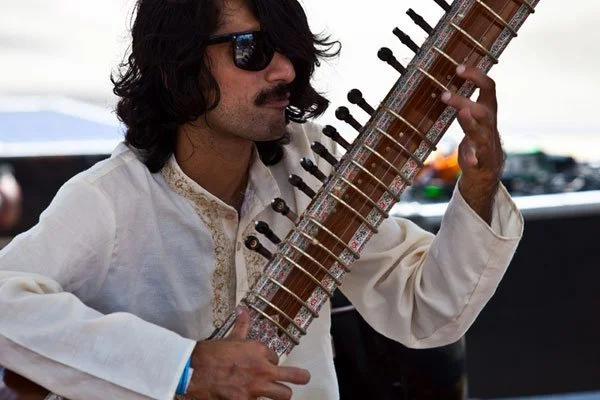
Definitely cinematic but it’s more earthy. It’s folky, it’s earthy and we draw influences from all sorts of cultures all over the world. I’ve studied West African music and I’m currently a student of classical Indian music. Luke is an amazing bluegrass musician and Marta has been in the symphony for 25 years. Her and Sarah both are classically trained. It’s really broad and none of us really listen to the same music. So maybe I would say it’s cinematic world folk music.

How would you describe the progression of the band from the first album to the new one?

The first album was released in 2004, so we’ve had quite a few years to develop since then. We’ve also added members to the band in the meantime who also serve as co-writers. They just bring so much to the table as far as the songwriting they’re contributing. We’ve developed over time. The first album was kind of a seed and this one is certainly more mature than the first one. I think it’s just the natural development over the years and a lot of hard work.

You mentioned that early on in life you didn’t feel like there was much life in the church. Has your perception changed?

Yes, in a lot of ways it really has but in all fairness, back then I was 10 years old and I lived in a little tobacco town in the middle of nowhere. There were probably more cows there than people. My worldview on that was probably not the most acute. It just had to become real in my own experience. I remember that, one of the first times I walked back into a church after so many years away, I found myself walking from the back of the church to the front on top of the pews. I just didn’t know the way things worked!

For me now, with music and worship music in particular, being such a thriving part of the church culture, that to me is where I’m finding a lot of life. There is a growing group of young, creative people who are not going to just write or rehash the same sounds and the same things that have been done for so many years prior. They’re wanting to express their personal conviction of God through their art and music and for me, there’s a lot of life in that. Like I said earlier, it’s just another form of communication. I love what I’m seeing but I think that in a lot of ways, the church has a long ways to go creatively. I think that it should be one of , if not the most creative force on earth.

Why is it not?

I would say the primary hindrance is fear. I think that more and more people are realizing that authenticity cannot be replaced by anything. The world is hungry to see something authentic. We’re done with the hype, we’re done with the slick expressions. The world really wants to see something real no matter where that comes from. I think it’s an opportunity for the Church to really become who She’s created to be. Music and art are wonderful vehicles to express that authentic devotion. I could care less about religion, to be honest, but I long for the reality of the presence of God. If I can encounter that presence and that person, then I think the rest kind of falls into place.

What can churches do to help foster communities of creativity?

I think that one thing churches could do would be allow their musicians and artists to create their own work rather than just being bound to playing songs that everyone is familiar with. Music is contextual and congregational music must be treated that way but even in the Bible, even with David, there are hundreds of different sorts of songs and some of them aren’t very pretty and not all of them are uplifting and I think that just having the freedom of creative exploration and not being afraid if something looks really wacky.

What’s next?

I’m really excited to see where the CD with Songs of Water goes. We’ve already had a real exciting reception even though it’s just now being released. We’re always writing new music and for me personally, I’m working on several books of poetry and I’m working on recording some of my own music. We’d really like to start playing out some more and see where it goes. We love playing theaters and this music really comes alive in that setting so we’re shooting for some venues like that. I’m excited. I think there’s a lot of good things coming.

Here is Songs of Water in 2007 performing their song “Tempest:”


  • Visit the Songs of Water official website
  • Visit Stephen Roach’s official website

Share and Enjoy: These icons link to social bookmarking sites where readers can share and discover new web pages.
  • del.icio.us
  • Digg
  • email
  • Facebook
  • Google Bookmarks
  • LinkedIn
  • StumbleUpon
  • Technorati
  • TwitThis
  • YahooMyWeb