Impress Or Impact? An Interview with Trevor Davis

February 3, 2010 at 8:05 am

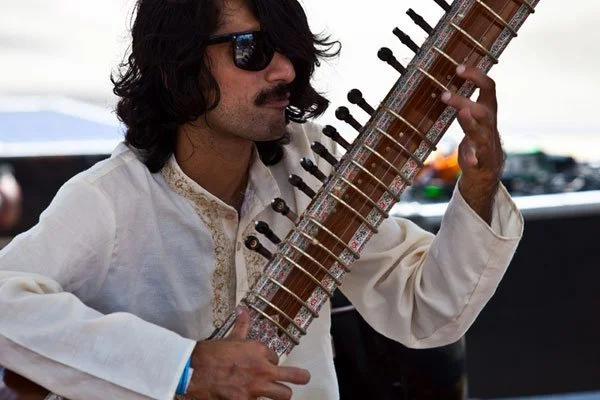
636004587_lI had the pleasure of meeting Trevor Davis a while back in Tacoma, WA. I heard him play at a house show in Aaron Spiro’s living room and I was immediately impressed. Though playing a solo acoustic set, it was anything but the typical folk you’d expect in such a setting. Trevor belted out a set of soulful, even funky tunes that immediately caught everyone’s attention. We recently had him play a house show in our living room much to the same effect. We also had him lead music for us at Church of the Cross. It’s a unique thing to find a great performer who is also a great worship leader. Meet Trevor Davis:

Were you raised in a musical home?

Not at all.

How’d you pick up music then?

I was raised in a single-parent situation. My Mom struggled with drugs and I wasn’t a planned birth so my Grandmother watched out for me while my Mom was out running around. Then she gave her life to the Lord when I was about 9 or 10 years old. She walked into this African-American church and basically just did a one-eighty with her life. Her life completely changed, she began walking towards Jesus and He was now Lord of her life. And so we started going to this all Black church where the music was amazing. So, no, I didn’t grow up in a musical family. No one in my family plays music but the fact that I was able to go to that church with the choir and the organ and all of these augmented chords; things that I didn’t even realize what they were until much later, that had a real impact on me.

Even now, I ask why it is that I don’t fall in love with the guitar playing G and D and I think it has to do with my subconscious remembering growing up with those harmonies and textures that are a little more complex. Sometimes they may not even know what they’re doing, they’re just going off of the feel. I don’t know what I’m doing either. I just go off of the feel too! I grew up with music, just not in my immediate family.

Was your Mother supportive of you pursuing music?

Yes, she was. Even though she didn’t make much money at all, I think I was in ninth grade and I wanted to play bass but the bass was like $200. That was a lot of money for us but she got me this bass. All her co-workers thought she was an idiot because, we were like, not even eating that month we got the bass! I never got an amp or even a case for the bass once I got it, but hey, I had a bass! I would borrow people’s stuff and would play in bands. She was always try and whatever she could pull off she would help with even though it usually wasn’t much.

At what point did you realize music was your life’s calling?

I got a Singelodeon, a cheap version of a karaoke machine in the fourth grade or something like that. Growing up in that church, I think my dream as a kid was just that when I grew up I wanted to sing in the choir. Not really knowing the choir was not that big, you know, this was a ghetto church and it wouldn’t have been like I was really accomplishing that much but that was my dream. I just knew that that was awesome and I wanted to partake in that. As I got older I just kept dreaming bigger and bigger and I just knew that I wanted to sing. In fact, it killed me not to sing and that just kept happening through my life even though I was so, so shy. But in spite of that shyness, it killed me that I couldn’t sing in front of people.

That church where I grew up, they had concerts like twice a year and they always picked me for the solo even though my knees were probably visibly shaking! But they kept picking the only white kid in the church so I guess I could sing a little bit and my pitch was probably pretty good or something.

Do you still struggle with stage fright?

Not at all. Besides those solos, I was always around the stage, at least playing bass and things like that. I started taking voice lessons at the very beginning of my senior year of high school. I didn’t tell nearly anyone, but I was taking voice lessons. I wanted to sing the national anthem or something big like that just to get out there. I told my voice teacher I wanted to work on that song so we worked on it together. I had to audition with the choir teacher and she had me sing the national anthem for her and she told me I wasn’t ready yet. So I gave it some more time and worked a lot on it and then I went and sang for her again and this time she said yes and gave me a date to sing. On that date, there was a huge basketball game, our school always went to the finals, so it was a packed-out game. Earlier that day before I had to sing at the actual game, she brought had me sing to her little ensemble to rehearse. Everybody could see my knees shaking! I was so nervous! They thought I sounded good, but I was like “shiver me timbers!” Then later that night when I sang at the game I was just so relaxed. Ever since then, I have never been nervous. I think just having done it at all, that cracked the egg and got me over that fear.

You tend to be a bit theatrical, How do you balance songwriting with also being a performer?

I’m actually having a really hard time with that right now. I recently moved to the Northwest, which is a very sort of “authentic,” not as showy place. Everyone has beards and flannel and they really listen to the content, which is great, don’t get me wrong, I love that. But I grew up in Southern California, where, you know, you have great shoes and they buy your CD. That’s a much easier thing to pull off: just go buy a pair of really cool shoes.

In high school I did Michael Jackson performances for talent shows. Again, another stage thing: I played bass and I danced for people, so that missing element was finally singing. I always wanted to bring that dance element into my music. The reason I feel like I’m having a hard time now with that balance is that I find myself sitting on my couch writing these folkier tunes with really deep content that touches my heart with a lot of emotion. Then I go and play a show in front of these young kids and the song doesn’t have the right energy. It has energy to me and it does to a certain group, but it is getting more niched in that sense. It’s not longer just this showy, uppity tune. So I just don’t perform those songs. If the setting is correct, maybe I’ll bust one or two of them out. In fact, I just had this experience where I thought it would be really cool to open up one of my shows with one of these really deep songs, and I started and everyone just started talking! That was really my first time with that experience. I can usually grab people’s attention. It kind of made me rethink performing these songs. As far as recording, I’d love to record some of them.

What’s your typical songwriting process?

For me, from the beginning, a big part of it has always been “OK, I have this guitar, how can I not make it sound like everyone else’s?” Also, “I have this lyric, how can I make it not cliché?” And “How can I make my melody not be cliché?” There’s a lot of music out there that just seems to be recycled. I want to create textures and things that are not the same thing just redone and redone. That’s a tough thing to accomplish but I also know that no one has my exact life. No one has my same story. So the years that I practiced as a kid on that karaoke machine, that comes into play and it’s being confident in that. I can now go out there and do my thing and let it be what it is. Before, I often felt pressure to sound like someone band-trevordaviselse popular, and it’s really hard not to want to do that. At the beginning I just did it out of fun, but I began to wonder if I was too weird or something. And then I listen to it and it’s not weird at all, but you just feel weird sometimes if you’re pursuing your own thing.

Does having an “alter ego” help in that tension between songwriting and performance?

Oh my gosh, artistically, that was one of the best things I have ever done as an artist. At the beginning, the first eight months or so that the Dr. Seahorse CD was out, I didn’t feel that way. CD’s cost at least around $10,000 or so to make, so when this Dr. Seahorse album came out and someone was searching for my name, because I perform as Trevor Davis, they weren’t finding this new album because it was under Dr. Seahorse, not Trevor Davis.

Now, as an outlet, I can take a song that’s maybe slow, deep and melodic like I’ve been writing, give it to the producer who does my Dr. Seahorse stuff and he’ll double-time it making it this brilliant, happy-fun thing even though it might be a really serious song. He doesn’t even always think about the lyrics, he just approaches it from making it as fun as possible and he does that well. So, being able to take those faster, more upbeat songs and make those Trevor Davis songs and making the others Dr. Seahorse songs has been really cool.

For those who might not be familiar, explain Dr. Seahorse

Dr. Seahorse is an electronic project that I do with a producer named Mark Suhonen, who had approached me years before I actually decided to go forward with it. He took one of my songs called “Grace,” took the vocal tracks and did a remix which I thought was pretty good but maybe not good enough to stop what I was doing. I was enjoying what I was doing. I wasn’t quite bored yet, I guess you could say. You know, I’ve done this acoustic thing for a while and I want to branch out. I was enjoying it at the time, but I kept hearing some of the tracks he was producing for other people and I kept thinking “Man, this guys is really getting better at what he does. He’s really sharpening his tools.”

So I came up with this idea for a five song EP to be done in a country, twang style. So I asked this producer to produce that, but I also asked Mark to produce those same five songs in his style, and I wasn’t going to let either producer hear the other’s thing. So I wrote up this vision, gave it to each producer and the country guy backed out and Mark was already flying away with his tracks and I didn’t want to stop him! They were coming out amazing but I didn’t know what to do with them. I couldn’t not let people hear them, but if I released them, people would wonder what the heck happened to Trevor?! I didn’t want my existing fans to get scared off so we came up with this other identity and then began to wonder how in the world we could perform these tracks live.

The whole thing seemed to be approached with questions and barriers, but we just kept jumping over them. He’s a drummer and he grew up doing drum line and things like that so he drums and does his DJ thing and I sing and dance around and it’s great. When we perform live, people are just having such a good time because we are having a blast.

Where did the name Dr. Seahorse come from?

Dr. Seahorse is kind of a folkier, 6/8 song I wrote quite a few years ago. It’s kind of an abstract song about dependency on God. I go around asking all of these sea creatures for help. One of them is an octopus and I ask him if he can lend a hand and one of them is Dr. Seahorse. People would just remember the title of that song and ask me to play it even years and years later. So when we were thinking of names, I just kept wondering what would be a name that people just won’t forget? We ret-titled that song a different name to put it on the album and named the artist Dr. Seahorse.

Would you mind talking about your salvation experience?

That was a slow process for me. I believe that we have been saved, are being saved and will be saved. It’s His power that has saved us but it’s also His power that is saving us. So, when we ask Christ into our hearts and then somehow believe that it’s up to us to save ourselves, I believe that slows the process. I had always been taught that it was up to me in some sense and I struggled with years of legalism, just trying to do it on my own. I think that that kept me “safe,” I didn’t go out and smoke weed or go out and party and stuff like that. I was scared of getting caught.

I had this youth pastor who had paid for me to go to this all Christian Jr. and senior high school. He paid for me to go all the way through, which was thousands of dollars. As a poor kid, I knew what I had. This opportunity was huge. I knew that I was sitting at this banquet and that my spot was undeserved. That was pretty cool. I knew where I was at and I didn’t want to hurt that. A lot of my friends were getting caught doing things and I just didn’t want to lose what I had. I feel like that has worked its way into my Christian life now. It’s not a fear that I can lose my salvation per se, but more, man, isn’t this awesome, what we have?! Isn’t it totally undeserved? Could I really let something else take the throne? You know, we all have fears, that we would not be successful enough or something like that. We worship what we fear and I’ve just really tried to focus on that fear of God.

For me, feeling like I was pulled out of my ghetto life and being given this awesome gift, that’s just always served as such a picture for me. I didn’t want to lose that gift. So, as far as growing up in that African-American church, not only did they believe in speaking in tongues, they believed that you had to speak in tongues to be saved. So I was this little kid going up every week being prayed for squeezing my little butt cheeks as hard as I could to speak in tongues thinking “Oh Lord, please let me start talking weird, I don’t want to go to hell!”

So I grew up with that for many years, and then I went to a Calvary Chapel and they got to wear shorts to church. I just thought “Man, this is really loose!” It was really fun! I got to go to this children’s church and they had puppets and nothing but fun stuff! We got to go to Magic Mountain and I felt really loved by a lot of the leaders, but the music, man, it was just so bad. I remember singing that song “Our God is an Awesome God” like a funeral dirge! I just felt like I didn’t believe a 203632083_lword they said by the way they sang it. And this was contrasted with the black church that I had been a part of where the music was just so alive but where I thought I was going to hell. So I finally figured out that I didn’t have to speak in tongues to be saved, which was freeing but the music didn’t sound nearly as free. I was just in this weird tension.

So I have always struggled with Christian music, since I left that church and have become friends with white, Christian musicians. I’ve always felt a lack of freedom. I got that freedom from the theology of salvation, but as far as the music that they were singing, I think the black church really set the standard for the rest of us in that freedom of expression. You know, the Beatles didn’t listen to a lot of white people but we love their music. Sometimes we love it packaged by white people even when we don’t have that freedom that opens the door. I think that we should look at that and not be so uptight.

Why do you think that so much “Christian music” lacks that freedom?

I’m not even sure. I guess, when you look at Jesus, He hung out with a lot of people like prostitutes who knew that they didn’t deserve it but they got it and then they were so freed by it. And I’m not just picking on white people but I wonder if those of us who have had good families and comfortable lives, the family that goes out to church and then goes out to dinner afterwards and soccer practice, I just wonder if at least part of worship for many of us has simply because part of life. I don’t know how many of us maybe feel like it’s deserved in some way because of our comfortable lives. I think many of us don’t understand the depth of just how much we don’t deserve salvation. I think maybe if we really swallowed that pill, we might be more free?

We forget what a feast, what a party worship should be. We forget how much we don’t deserve it in the first place. We spend so much time and effort trying to control our environment and it’s not freeing, it’s really hard and expensive and many of us are in a lot of debt because of it. We have debt to the wrong masters. The people Jesus frees, He pays their debt in a different way. If I went to one of those families and paid all of their debt, I bet they would finally start singing a song!

Is there a relationship between that and something like contemporary “Christian” music that is often over-packaged and sterile?

Well, when you look at that type of music, who is their number one listener? It is the soccer Mom who deals with all of those things we just talked about. So, when your top market is “adult contemporary,” that is who its packaged for so I can’t really blame them. If I sold hot dogs, of course I’m going to sell them at a baseball game! People like hot dogs at baseball games. If soccer moms with sheltered lives are the ones buying CCM music, then that’s who you package it for, it’s all marketing. When I realized that, I didn’t have any bitterness towards it. I don’t want to impress, I want to impact people.

Do you intentionally seek to incorporate your faith into your music or is it just naturally part of life?

There have been different eras of my life as far as that goes. Coming from that legalistic approach in my walk, when I realized that it’s by faith that we’re saved by God’s grace, I definitely tried to push that in my music to free people, but I was almost not free in my pushiness of that.

You know, there are three areas, Prophet, Priest and King. The Prophet tends to really focus on Truth, the Priest focuses more on the counseling or feeling and the King is the organized one. As an artist, I’m not a King, as an artist, you have to be Priestly, which is emotional and as a songwriter, you need to also be Prophetic. When I first started, I didn’t ever want to write songs, I just wanted to sing other people’s songs. I just wanted to sing, I just wanted to be emotional. But as I started writing songs, I had to become more Prophetic and I probably went a little overboard, pushing that truth and now it’s about trying to find that balance. It’s not my job to be in control, it’s God’s so that allows for some more freedom in my lyrics. I used to feel that pressure, so I tried to put the whole salvation message into every song. I wanted people’s entire lives to be changed after that three minute song was over! But, of course, it takes more than three minutes! It’s He who began a good work in you that will complete it and if it is God’s work then I can’t even step to the plate. If He actually calls it work, then I don’t think I have the strength to do it!

You mentioned the kingly aspect, how do you balance the business side of things with the artistic side?

My wife cares about the inside organization of things and I tend to care about the outside, the feng shui of the house, things like that, so we work really well together. I’m very strategic, I like chess and in the music business, that’s really helped me to think long-term. I’m not going to play one time in Yugaslovia and never return. I’m going to play where I can build relationships. What’s the point of spending all that money and energy if you’re not building anything? I’ve always wanted to be the kind of artist that has depth with my listeners. So I’ve thought a lot about those strategies and then my wife helps put them into action, she helps fill out the back end of a lot of things.

Why did you move from San Diego to the Northwest?

I was touring up there a lot and I just connected with those people. I feel like their mentality, the way that they do music, the way that they do church, the way that they are in conversation is just very genuine, very real and deep. You can talk to a random person and feel like the conversation takes off right in the middle and it just takes off like you’ve already known the person. You don’t have to dance around things, you just dive in. I was in San Diego and often felt like a bit of an outsider in some of those regards.

I just kept thinking that I wanted to live up there. And as I toured up there a lot there was a church that I just really connected with; what they were doing and the seriousness that they call themselves to, I just thought it was amazing. It’s not just playing the game of church. I feel like as a kid, I felt like church was sort of like playing house or other games. A lot of us just don’t know what this Gospel should look like in real life and that’s one of the main reasons I went up there was to be part of this church.

How do you approach leading worship differently than other musical performance?

Well, the church where I’m at now, we work really closely with whoever is preaching and tie everything to the message. We do a couple of songs up front, then the sermon then we do most of our singing after the sermon and for the first time that’s really made sense to me. Worship has become a true response to the Word and I feel like that’s often lacking. We’re always trying to get people energized and excited and music can be that, but when it’s only music, that’s all it is. When we encounter the Truth and then respond to it, it is so much more exciting.

Who are some of the artists who have influenced you?

For me, I’ve separated the idea of influence into two compartments: impress or impact. I’m actually going to write a book on this. Impress is sometimes what we as Americans live or die for. What is it that we’re slaving for? Sometimes it’s material things, sometimes not but it’s often not eternal stuff because we are easily impressed. When you’re impressed by something, just like the Kit Kat candy bar, the letters are actually impressed into the chocolate. Whenever there is an impression, it actually robs the original of something. You’re actually left with less chocolate. If I were to impress you, I’m kind of poking my finger into you and you’re actually smaller than you were before.

I think that’s a lot of what we do. Churches are trying to be impressive so they try to make the church up the street maybe feel not quite up to par. It happens across the board, we’re always trying to impress each other. We think that that’s how we can build ourselves up when actually we’re digging ourselves into a whole and robbing others in the process.

So I try to replace that word “impress” with “impact.” Impact is when you are overflowing, like in Psalm 1, you’re a tree planted by rivers of water. In whatever season, you’re always bearing fruit. If you’re always bearing fruit, you’re always in abundance. If you can be that figure to others, you’re not trying to get from others, you’re there to give and love freely. Maybe what you give is not what you think you should be giving, maybe it’s time or companionship or something like that. People pay others to listen to them! It’s amazing how we can impact others just by being interested!

So for me, influences in life have been anything from The Beatles to Michael Jackson. Led Zeppelin, all these other people. They impressed me. I felt like, sitting in my room with my guitar and karaoke machine, I didn’t have what it took to be an artist. What they did was way too impressive because I couldn’t even get started. I pictured them as the starting point. Using Bob Marley as an example, Lauryn Hill said once that we could never be like Bob Marley. Truth is never from the outside in. We have not had his life, the pain and suffering that went in to his music shaped him and that 20-piece band just happened. He wasn’t trying to impress people. If it just happens, I bet you it will be impactful.

I remember, I used to go see Jason Mraz with just a guitar, not even a PA system. He wasn’t impressive, he wasn’t a big deal, and I would go see him play and I would see him dance around and when I saw him, he was having fun. There’s another guy, Ricky Andrade, he’s one of my favorite singers. These guys gave me a starting point. I took their impactfulness and applied it to my life. The artists that impact me are not always the most glamorous. Jason Mraz impacted my life without a PA and now that he’s got all these albums out, but they’ve done nothing for my life. Not that they’re not good, they just don’t have the same effect.

What’s next?

Thank God, the guy who paid for me to go to the private school, he believes in what I’m doing. I never had a father figure and he’s been that for me. He’s done very well in business and helps me out with new albums and things and he wants two albums this year, a Trevor Davis and Dr. Seahorse album. Also, with that book, there’s a writer who lives like two blocks from my house and she knows a lot of technical writing things and when I asked her, she was almost in tears and she just felt like this was right. I don’t have to be impressive, all these things are just in the right place.

  • Visit Trevor Davis’ website
Share and Enjoy: These icons link to social bookmarking sites where readers can share and discover new web pages.
  • del.icio.us
  • Digg
  • email
  • Facebook
  • Google Bookmarks
  • LinkedIn
  • StumbleUpon
  • Technorati
  • TwitThis
  • YahooMyWeb